
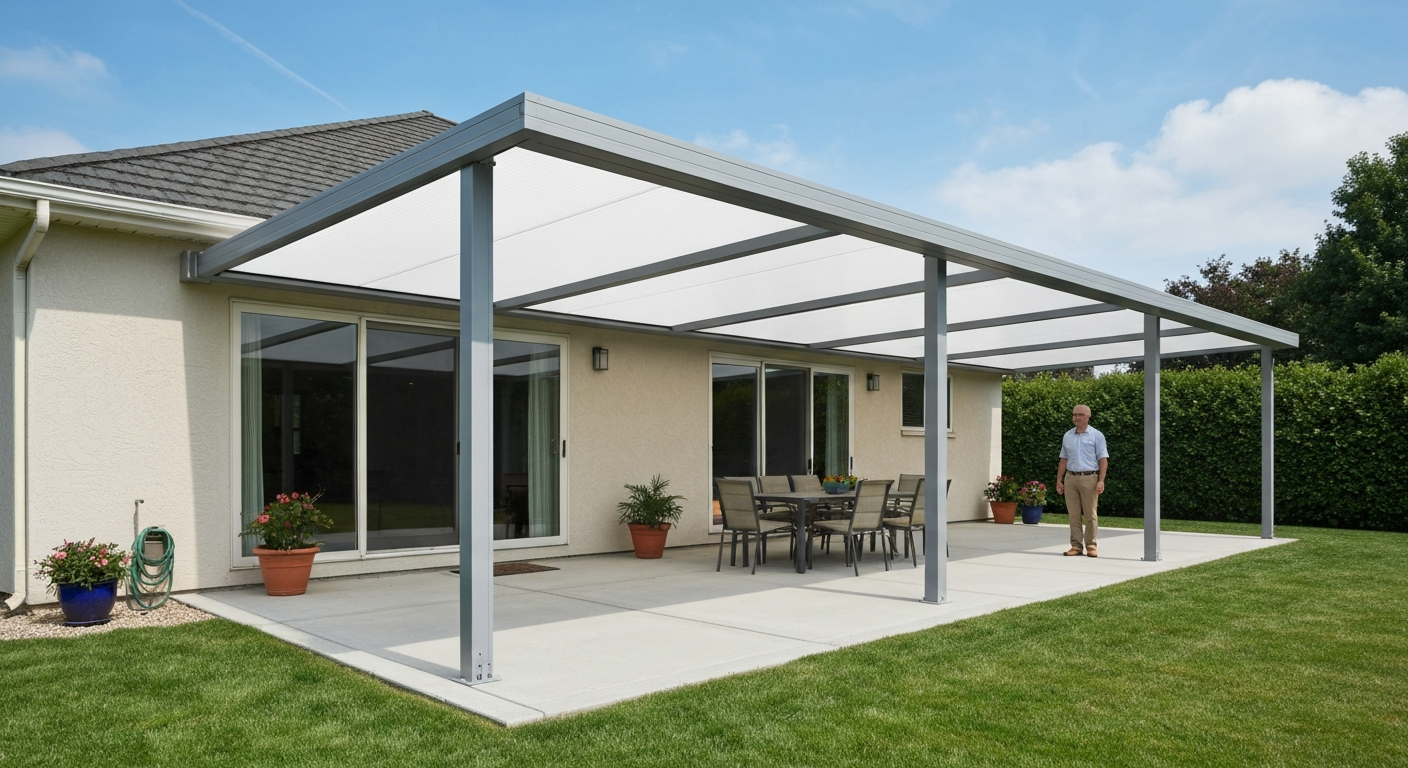
The Palram Feria is a solid mid-range patio cover that works well for most homeowners who want a clean, modern look with real UV protection and a straightforward DIY assembly. It uses a powder-coated aluminum frame and twin-wall polycarbonate panels, comes in modular sizes from 10x10 up to 10x34 feet, and retails from roughly $800 for a small kit to over $5,100 for the largest configurations. It holds up well in sunny climates and handles moderate snow loads, but it runs hot in peak summer without airflow accessories, and a handful of recurring owner complaints, about panel delamination, gutter drainage, and warranty service response, are worth knowing before you commit.
Palram Feria Patio Cover Reviews: Complete Buyer's Guide

Phoebe Foster
22 Jul 2026
Quick verdict
The Feria is a worthwhile buy if you prioritize a clean aesthetic, modular sizing flexibility, and genuine DIY assembly without professional help. It is not the right pick if you live in a region with very heavy snow loads, if you need maximum summer cooling, or if hands-on warranty support is non-negotiable for you. For most suburban patios in mild-to-warm climates, it delivers on its core promise.
What the Palram Feria actually is
Canopia by Palram markets the Feria as a wall-mounted patio cover kit designed to attach to an existing house wall on one end and stand on free-standing posts on the other. The design intent is a lean-to structure: a single-slope roof that sheds rain toward the outer edge, keeps the mounting side low-profile against your exterior wall, and gives you a defined covered zone without the commitment of a full pergola or room addition. Palram originally built its name in polycarbonate glazing for greenhouses, and the Feria applies that same material expertise to outdoor living. The result is a cover that diffuses light rather than blocking it entirely, so you get shade without turning your patio into a dark tunnel.
The typical buyer is someone replacing a worn fabric awning or a rotting wood pergola and wanting something that looks intentional, handles rain, and stays manageable as a weekend DIY project. It is not a screened room, not an insulated patio room, and not a carport-grade heavy structure. Keep those use cases in mind as you read.
Specs and configurations at a glance
Palram publishes model-specific assembly PDFs and technical datasheets through its downloads portal, and the major retailers list individual SKU specs clearly. Distributor and reseller pages list specification tables for each model, for example, the Canopia by Palram Feria 13 ft. x 20 ft. Patio Cover Kit - Twin wall | SelectSheds provides coverage area, assembled height/clearance, package lengths, and roof/snow load figures. Here is what the documented specs look like across the main configurations.
| Spec | Detail |
|---|---|
| Frame material | Powder-coated aluminum (anti-rust finish) |
| Roof style | Single slope (lean-to) |
| Glazing material | 6mm twin-wall polycarbonate panels |
| Glazing options | Clear or white (opal/diffused) |
| Frame color options | White or grey |
| Modular size range | 10x10 ft up to 10x34 ft (in ~6-ft depth increments) |
| Roof pitch | Fixed single slope (low pitch, integrated into kit design) |
| Snow load rating | Approx. 31 lbs/sq ft (per retailer listings) |
| UV protection | Up to 100% UV blockage (white/opal panels); partial with clear panels |
| Assembly crew | 2 people recommended |
| Estimated assembly time | 6–8 hours for standard kits |
| Warranty | 5-year or 10-year limited (varies by model/region) |
The 31-lb snow load figure appears on Lowe's listings for several Feria SKUs, and Palram's technical documentation backs up the polycarbonate panel properties. That said, rated load and real-world performance depend heavily on proper anchoring to structure (studs or concrete, not just sheathing), so do not treat the published number as a guarantee if your installation skips the anchoring steps.
Available sizes and how modular works in practice
The Feria line runs from a 10x10 ft starter kit up through 10x12, 10x14, 10x18, 10x20, 10x24, and 10x34 ft configurations. The '10 ft' figure is the projection depth from the house wall out, and the second number is the width running parallel to the wall. Palram also sells the Feria in metric sizing for international markets (e.g., 3x3m, 3x5.4m), which shows up in some Costco-hosted PDFs and the Australian Canopia site.
Modularity here means you buy the kit for your target size rather than snapping smaller kits together like Lego blocks, each configuration ships as its own pre-packaged kit with a specific parts list. If you need a 10x28 ft cover, you are not combining two 10x14 kits; you buy the appropriately sized model. Canopia does note that some configurations can be extended with additional modules, but check the specific model's documentation before assuming that applies to your size.
Post positioning is adjustable within limits, the Feria uses flexible positioning poles that allow you to shift the outer posts inward slightly from the roof edge, which helps when you have a planter bed or uneven patio edge. This is a genuine practical advantage over competitors with fixed-post positions.
Materials and build quality up close
The aluminum frame
The Feria frame is extruded aluminum with a powder-coat finish. Aluminum does not rust, which is the right call for an outdoor structure, and the powder coat adds a secondary layer of corrosion and scratch resistance. In practice, most owners report the frame holds up well to weather over multiple seasons. Where complaints show up is in the fasteners and brackets: several owner reviews on Lowe's and Home Depot note that included hardware feels lightweight relative to the frame profiles, and a handful of BBB complaints document missing or damaged small parts in shipped kits. The frame itself rarely draws criticism; the ancillary hardware gets more scrutiny.
The polycarbonate glazing
Palram uses twin-wall polycarbonate for the Feria roof panels. Twin-wall means the panel has two parallel sheets connected by internal ribs, creating air pockets that add some insulating value compared to single-sheet acrylic. The panels are 6mm thick. Palram's own Palsun Technical Guide (available on their downloads portal) details the UV-blocking co-extrusion layer on the outer surface, which is what actually prevents panel yellowing and degradation over time. This matters because polycarbonate without that UV cap layer will turn yellow and brittle within a few years outdoors.
The clear panels transmit a high percentage of natural light but also transmit heat, making them better suited for cooler climates or covered areas where you want brightness. The white (opal) panels diffuse light and provide significantly better solar heat gain control, plus the manufacturer claims 100% UV blockage for that option. If you are in a sunny climate like Texas, Arizona, or Florida, the white panels are the practical choice, clear panels will make a south-facing patio uncomfortably warm in summer.
The Click N' Lock roofing system
Palram's assembly PDFs describe a Click N' Lock panel-to-frame connection that snaps panels into the aluminum glazing bars without requiring specialized tools. In theory this speeds up installation and seals panels without exposed fasteners. In practice, owners report that the panels do click in fairly cleanly, but alignment during installation requires patience, rushing that step leads to panels that are slightly off-square and harder to seal at the ridge and eave.
How it holds up in different climates
Sun and UV exposure
This is where the Feria performs best relative to fabric awnings and untreated wood pergolas. The UV-blocking co-extrusion on the polycarbonate panels is the real differentiator. Owners in high-UV regions (Southwest US, Florida, coastal California) consistently report that the structure itself does not visibly degrade over the first three to five years. The caveat is heat: twin-wall polycarbonate, even with the opal finish, allows infrared heat through. On a 100-degree day in Phoenix, the air temperature under a Feria will still be uncomfortably hot without ceiling fans or misting. The cover blocks UV and most direct sun, but it is not insulated roofing.
Heat and light transmission
Clear panels transmit roughly 82% of visible light and a high fraction of solar heat. White/opal panels cut light transmission significantly (typically to around 40% for standard twin-wall opal), which meaningfully reduces heat gain underneath. The twin-wall air gap provides modest thermal resistance compared to a single-layer panel, but it is not comparable to an insulated aluminum patio cover. If reducing summer heat under the cover is your primary goal, plan to pair the Feria with a ceiling fan or misting system from day one.
Wind resistance
The lean-to design and low roof pitch are inherently lower-wind-resistance than a steeper-pitched structure, which is actually an advantage in wind. Palram's Miami-Dade approval documentation (hosted on their downloads portal) confirms the structure has passed testing relevant to high-wind requirements. However, this approval applies specifically to properly anchored installations. Owners who anchor into wall studs and properly secure post bases to concrete footings report no wind issues even in stormy conditions. Those who used toggle bolts into drywall or skipped post anchoring report structural movement and panel displacement in moderate wind events.
Snow loads
The documented 31-lb/sq ft snow load rating is workable for most of the continental US Midwest and Northeast if the structure is properly installed. For comparison, most standard residential roof framing is designed for 20-40 lbs/sq ft depending on region. That said, heavy wet snow accumulation is the risk scenario with any polycarbonate cover: the panels can flex, and if standing water freezes in the gutter channels, drainage problems compound. Several Midwest owners recommend clearing heavy snow accumulation from the panels after major storms rather than relying on load rating alone. If you are in a high-snowfall zone (northern Minnesota, upstate New York, mountain regions), consult a local contractor before installing any flat-profile polycarbonate cover.
Coastal and salt-air conditions
The powder-coated aluminum frame is the right base for coastal exposure, but powder coat is not immune to salt-air degradation over time, it just lasts longer than bare steel. Owners within a mile of the ocean report that annual cleaning with mild soap and fresh water (per Palram's polycarbonate care guide) meaningfully extends both frame finish and panel clarity. The polycarbonate panels themselves hold up well to salt air since they are non-metallic, but the frame joints and hardware are worth inspecting annually if you are close to the coast.
What real owners actually say
Pulling from Lowe's and Home Depot review sections, Trustpilot entries for Canopia, and BBB complaint records gives a reasonably clear picture of where the Feria earns praise and where it frustrates owners. For a broader roundup of owner feedback and side-by-side comparisons, see try-tech patio cover reviews.
What owners like
- Clean, modern appearance that upgrades the look of a patio noticeably compared to a fabric awning or open pergola
- Assembly instructions described as clear and follow-able for two people with basic DIY skills
- Panel installation via Click N' Lock system praised for not requiring specialized tools
- Aluminum frame consistently described as solid and well-finished out of the box
- UV protection noticeably effective — owners report furniture and flooring fading significantly less than before
- Modular size range gives more footprint options than most competing kit brands
- Adjustable post positioning appreciated when patio edges are irregular
Common complaints
- Panel delamination or internal condensation reported by a subset of owners after one to two seasons, particularly in high-humidity climates
- Gutter channel overflow and clogging in heavy rain, especially on larger configurations where the single gutter cannot drain fast enough
- Hardware (screws, brackets, end caps) described as lightweight and prone to stripping during assembly
- Missing or damaged small parts in shipped kits documented in multiple BBB complaints and retailer reviews
- Customer service and warranty claim resolution described as slow or difficult in multiple Trustpilot and BBB entries
- Clear panels create a greenhouse effect in summer heat — owners in hot climates wish they had chosen opal panels
Representative themes from owner feedback
A recurring theme across positive reviews reads something like: 'Took my husband and me a full Saturday, but the instructions were actually usable and the end result looks like it cost twice what we paid.' On the negative side, the most common frustration is not the structure itself but the support experience: owners report that when something goes wrong, a cracked panel, a missing bracket, a leaking gutter end cap, getting a replacement part from Palram/Canopia takes longer than it should, and some owners end up sourcing compatible hardware locally rather than waiting. The product itself tends to get 4 stars; the company support experience averages closer to 3.
Installation: DIY vs. hiring it out
What DIY actually involves
Palram designed the Feria for two-person DIY assembly, and the assembly PDFs on ManualsLib and the Canopia site walk through the process step by step. The kit comes with pre-drilled profiles and labeled hardware bags. Most owners report 6 to 8 hours for a 10x10 or 10x12 kit, stretching to a full weekend for larger configurations like 10x24 or 10x34. You will need a drill, a level, a ladder, and basic hand tools, no masonry anchors or concrete are required for the post bases if you are working on an existing concrete patio, though Palram does recommend anchoring posts to concrete footings when not attaching to masonry for structural stability.
The wall attachment is the most critical step. Canopia's documentation is explicit: mount into structural members (studs or concrete block), not just into exterior sheathing or stucco. Owners who skipped this step report wall pull-through in wind. If your home has stucco over foam insulation, you will need to locate studs carefully or use a structural ledger. That is the step most likely to push a confident DIYer toward hiring a handyman for at least the wall-mount portion.
When to hire a professional
Hire a handyman or general contractor for the installation if your mounting surface is challenging (stucco over foam, brick, or irregular siding), if you need a permit and your jurisdiction requires professional installation documentation, or if your kit is 10x24 ft or larger and you do not have a second person with genuine comfort on a ladder. A handyman-level installation for a mid-size Feria typically runs $300 to $600 in labor depending on your region and complexity. A licensed contractor installing on a challenging wall type with permit coordination can run $800 to $1,500. Neither of those numbers is alarming relative to the kit cost on a larger configuration.
Pricing and value
Feria kits are sold primarily through Lowe's, Home Depot, and directly through Canopia's website, with occasional availability at Costco and specialty outdoor retailers. Pricing scales predictably with size. A 10x10 white-frame/white-panel kit runs approximately $800 to $900 at major retailers. A 10x20 configuration lands around $2,000 to $2,500. The 10x34 configuration is listed at Home Depot at $5,116.19. Those are retail prices without installation. On a square-footage basis, that works out to roughly $8 to $15 per square foot for the kit alone, which positions the Feria in the middle of the DIY patio cover market, below custom aluminum patio covers installed by contractors ($25 to $60/sq ft installed) and above basic polycarbonate pergola kits from budget brands.
The value proposition holds best for homeowners who do the installation themselves and need a cover in the 10x14 to 10x20 range. At that size, you get a finished-looking structure for $1,200 to $2,500 all-in, which would cost $4,000 to $10,000 if contracted out as a custom aluminum patio cover. The value story weakens for large configurations where the kit price approaches contractor-built territory and the complexity of DIY assembly increases.
How the Feria compares to other patio cover brands
The Feria sits in a category with several other branded patio cover options, some DIY-kit-focused and some contractor-sold. For broader comparisons and buyer-focused analysis, see our patio cover concepts reviews for side-by-side evaluations and buying guidance. Here is how the main competitors stack up across the dimensions that matter most to homeowners. For a direct comparison to other consumer-reviewed models, see Oasis patio cover reviews for user-reported pros and cons.
| Brand/Product | Frame Material | Glazing/Cover Type | DIY Friendly | Price Range (kit) | Best Climate Fit | Warranty |
|---|---|---|---|---|---|---|
| Palram Feria | Powder-coated aluminum | Twin-wall polycarbonate | Yes (2-person, 6-8 hrs) | $800–$5,100+ | Mild to warm/sunny | 5 or 10-year limited |
| MR Patio Cover | Aluminum | Solid aluminum panels | Moderate | Varies by dealer | All climates | Varies by dealer |
| HHI Patio Covers | Aluminum | Solid insulated panels | Contractor-installed | Higher (custom) | Hot climates | Contractor warranty |
| Acrylite / Evonik | Varies (DIY panels) | Acrylic sheet (clearer than PC) | Panels DIY; framing separate | Material cost only | Moderate UV climates | Product-specific |
| Oasis Patio Cover | Aluminum | Solid/insulated aluminum | Contractor-installed | Custom pricing | Hot, sunny climates | Manufacturer + contractor |
| Temo Patio Covers | Aluminum | Insulated solid panels | Contractor-installed | Custom/higher | All climates | Lifetime structural |
| Try-Tech Patio Cover | Aluminum | Solid aluminum panels | Contractor-installed | Custom pricing | Varies by region | Contractor/mfr warranty |
The key distinction is insulated solid panels versus polycarbonate glazing. Brands like Temo, Oasis, HHI, and MR Patio (which you can read more about in dedicated reviews elsewhere on this site) use solid insulated aluminum panels that block heat and light entirely, making them better for maximum summer cooling but eliminating natural light. The Feria trades some heat performance for a brighter, more open feel. If you want natural light under your cover, the Feria wins. If you want a genuinely cooler outdoor room, the contractor-installed insulated-panel brands win. Acrylite panels are an interesting DIY alternative for custom framing projects where you want optical clarity beyond what polycarbonate offers, but they require more planning since you source the glazing separately. For a deeper comparison of clarity, heat performance, and DIY considerations, see our Acrylite patio cover review.
Accessories worth adding
The Feria works fine as a standalone structure, but a few additions make a meaningful difference in real-world usability. A ceiling fan rated for damp outdoor locations is the single highest-impact upgrade for any hot-climate installation. Mounted to the underside of the Feria's beam structure, a 52-inch outdoor fan drops the perceived temperature by 8 to 10 degrees on still summer days. Canopia's own accessory line includes LED strip lighting kits designed to fit the Feria's beam profiles, which look clean and avoid the mess of surface-mounted conduit.
For the gutter overflow issue that owners commonly report, adding a downspout extension or a secondary drain point on larger configurations addresses most drainage problems. A misting system along the outer beam is worth considering in climates above 90 degrees Fahrenheit, the combination of the Feria's shade and a misting line produces genuinely comfortable outdoor temperatures that a cover alone cannot. Gutters and downspouts from Palram's compatible accessory list are available, but standard residential gutter components from a hardware store can also be adapted to the Feria's aluminum extrusions with basic brackets.
- Damp-rated outdoor ceiling fan (52-inch recommended for 10x10 to 10x14 spans)
- Canopia LED lighting kit or compatible low-voltage strip lights in the beam channels
- Misting system along the outer beam for hot-climate installations
- Downspout extension or additional drain point for configurations 10x20 and larger
- Anti-drip tape or upgraded end caps for the gutter channel to reduce leaking at joints
- UV-stable outdoor sealant for wall-mount flashing joint (applied annually in high-rain climates)
Maintenance and common troubleshooting
Palram publishes a Polycarbonate Care and Maintenance guide through its downloads portal, and the guidance is straightforward. Wash the panels twice a year with a mild soap solution and a soft cloth or sponge, no abrasive pads, no solvent-based cleaners, which can degrade the UV-protection layer. Rinse with clean water. That is genuinely all the panels need in most climates. In areas with heavy tree pollen or debris, quarterly cleaning keeps panel clarity and prevents debris buildup in the twin-wall flutes at the panel ends.
The frame needs annual inspection of fasteners and wall-mount hardware. Powder coat chips can be touched up with matching aluminum touch-up paint from a hardware store to prevent corrosion at the exposed metal. Coastal installations should get a fresh-water rinse of the entire structure after major storms and at least twice a year to clear salt accumulation from frame joints.
Troubleshooting the most common issues
- Gutter overflow in heavy rain: check that end caps are fully sealed; add a second downspout outlet on spans over 16 feet
- Panel condensation between walls: ensure both ends of the twin-wall flutes are sealed with flute-end tape (sometimes missing from kits); this prevents moisture ingress
- Panel yellowing after several years: if the UV cap layer has degraded, panels need replacement — Palram sells replacement panel stock; yellowed panels cannot be restored with cleaning
- Wall-mount bracket movement: re-drill and anchor into studs or masonry if mounting has shifted; toggle bolt anchors are not adequate for long-term structural loads
- Stripped hardware during assembly: source M6 stainless steel replacements at any hardware store; the included fasteners are functional but not robust enough for over-torquing
Warranty and customer service: the honest picture
Palram/Canopia offers either a 5-year or 10-year limited warranty depending on the model and the region where it is purchased, both warranty documents are available as PDFs from retailer pages and Palram's site. The limited warranty covers manufacturing defects in materials and workmanship but excludes cosmetic damage, improper installation, and normal weathering. That is standard language for this product category.
Where the warranty becomes a practical issue is in claim execution. BBB complaint records for Palram Americas document multiple disputes involving missing parts in shipping, warranty claim denials after inspection, and slow resolution timelines. Trustpilot reviews for the Canopia brand across multiple regional sites echo similar themes: the product itself often gets decent marks, but warranty service interactions generate the most negative sentiment. This does not mean your warranty claim will fail, many owners report receiving replacement parts without incident. It does mean you should document your installation with photos (showing proper wall anchoring, post base anchoring, and panel installation) from day one, keep your purchase receipt, and register the product if Palram offers registration at time of purchase.
Feria vs. DIY alternatives
If the Feria price point is too high for your budget, there are two realistic DIY paths. First, a basic wood pergola with polycarbonate roofing panels (Palram's own Suntuf corrugated panels or similar) runs considerably less, you can cover a 10x12 space for $400 to $700 in materials if you are comfortable with basic framing. You lose the clean factory-finished look but gain flexibility in dimensions and can use standard lumber you can source locally. Second, a fabric shade sail or retractable awning costs $150 to $500 for comparable coverage but provides zero rain protection and typically lasts three to five years before fabric degradation requires replacement.
The Feria makes sense over a DIY wood-and-panel build if you want consistent aesthetics, modular sizing without custom cuts, or if your local building department is more comfortable approving a manufactured kit with documented specs than a custom wood frame. It makes sense over a fabric solution if rain coverage is a requirement and you want a structure that looks permanent rather than temporary.
Regional buying guidance
Your climate should drive a few specific decisions when configuring a Feria. In the Sun Belt (Texas, Arizona, New Mexico, Florida), choose white/opal panels over clear without exception, and budget for ceiling fans or a misting system on day one. Clear panels in a Phoenix or Houston summer create a greenhouse rather than a comfortable outdoor room. In the Midwest and Northeast, the 31-lb snow load rating is adequate for most areas, but if you are in a lake-effect zone or a mountain-adjacent region that regularly gets 18 or more inches of snow in a single event, either consult a structural engineer about your specific site conditions or consider a contractor-installed solid-panel cover like a Temo or HHI product. For independent comparisons, see temo patio cover reviews. For comparisons and owner feedback on similar solid-panel options, see hhi patio covers reviews. Along the Gulf Coast and Atlantic Coast, prioritize proper wall anchoring with hurricane-rated hardware and inspect frame joints annually for corrosion. In mild Pacific Coast climates (coastal California, Pacific Northwest), the Feria is arguably at its best, the rain protection is genuinely useful, UV is manageable, and heat load under the cover is not a major concern for most of the year.
Final buying checklist
Before you purchase, work through these questions honestly. They will tell you whether the Feria is the right fit or whether a different cover type will serve you better.
- Measure your patio and confirm which Feria size covers it — remember the depth is fixed at 10 ft; if you need 12 ft of depth, the Feria does not accommodate that
- Identify your wall mounting surface and confirm you can anchor into studs or masonry; if not, plan for a ledger board installation or hire a handyman
- Decide white/opal or clear panels based on your climate — if you get more than 80 days above 90°F per year, default to opal
- Check your local permit requirements; some jurisdictions require a permit for attached patio structures over a certain square footage regardless of the kit's certifications
- Budget for at least one accessory (fan, misting, or gutter extension) depending on your climate; the base kit alone is rarely the full solution
- Confirm two people are available for assembly day and that you have a full Saturday available (not an afternoon)
- Register your product and photograph your installation for warranty documentation from day one
- Compare the Feria price against at least one contractor quote for an insulated solid-panel cover if your primary goal is summer heat reduction rather than rain cover and light diffusion
FAQ
What product specification data is required to write the technical overview and specs section?
Collect official model lists and SKU numbers; available modular sizes and coverage areas (imperial and metric); frame materials, finishes (powder‑coat colors), and member cross‑sections; roof glazing types, panel construction (twin‑wall polycarbonate thickness and UV treatments), translucency/visible light transmission (VLT) and stated UV blocking percentage; roof slope, assembled height/clearances, footprint and package dimensions; wind and snow load ratings, mounting options (wall‑mounted, freestanding), recommended anchor types and footing details; included parts lists and fastener types; advertised hail/impact or fire ratings (e.g., UL, Miami‑Dade). Source: Palram/Canopia product pages, technical datasheets, downloadable assembly PDFs, and retailer spec listings (Lowe’s, Home Depot, Costco).
Which primary manufacturer documents and files should be obtained and reviewed?
Download Feria product pages and all model‑specific assembly/installation PDFs; Palram technical datasheets (Palsun, polycarbonate guides); warranty PDFs for relevant regions and product families; Miami‑Dade or other approvals; flammability/UL documents; Care & Maintenance guides. Source: Palram/Canopia official website downloads portal and regional product pages.
What owner feedback data should be collected to synthesize real‑owner pros and cons?
Aggregate user reviews and Q&A from Lowe’s, Home Depot, Costco, Tractor Supply, and retailer forums; Trustpilot and BBB complaint histories; reseller review pages and social media posts (Facebook groups, Reddit threads); common themes: assembly difficulty, missing/damaged parts, panel delamination or hazing, gutter performance, fastener corrosion, wind/snow performance, customer‑service responsiveness. Collect representative review excerpts, counts/percentages for recurring issues, and response threads where manufacturer intervened.
What climate‑performance data and sources are needed to assess durability by climate type?
Manufacturer material property tables (UV stabilization, impact resistance, heat deflection temperature); stated snow and wind load ratings per SKU; regional failure/complaint patterns from reviews (e.g., northern snow claims vs. southern UV complaints); corrosion exposure info for coastal salt spray (material finishes and stainless/hot‑dipped fastener use); independent testing standards for polycarbonate and aluminum in UV, heat, and salt spray when available. Sources: Palram technical guides, retailer spec sheets, owner reports, third‑party material tests or standards (ASTM/ISO documents where relevant).
What installation and permitting research questions should be answered?
Is the Feria sold/designed for DIY assembly or professional installation per model; recommended crew size and estimated assembly time by model; full tool list and special tools required; typical site prep (footing/concrete anchor recommendations) and when structural attachments require flashing or tilt/side walls; local permit triggers (area, attached vs freestanding, electrical integration for lights/fans); typical professional install cost ranges and regional labor rates. Sources: Canopia assembly manuals and videos, retailer Q&A, contractor quotes, local building code guidance.
What pricing and value metrics must be compiled for a thorough analysis?
List MSRP and current retailer prices across common configurations (10x10 up to 10x34) and regions; package contents vs price (what’s included vs sold separately); average installed cost ranges (DIY vs pro); expected lifespan and total cost of ownership estimates (purchase + installation + maintenance + replacement panels); competing product price points for similar coverage. Sources: Home Depot/Lowe’s/Costco listings, distributor pages, contractor estimates, marketplace price history.
Next Articles
HHI Patio Covers Reviews: What to Check Before You Buy
Use hhi patio covers reviews to judge shade, weather durability, wind load, install support, costs, and best fit by clim
Patio Cover Concepts Reviews: Compare Types, Costs, and Contractors
Compare patio cover concepts with contractor ratings: costs, materials, durability, warranties, permits, and bid checkli
Mr Patio Cover Reviews: Pros, Cons, Cost, and What to Ask
Mr Patio Cover reviews with pros, cons, costs, key questions to ask, red flags, and quote comparison tips.