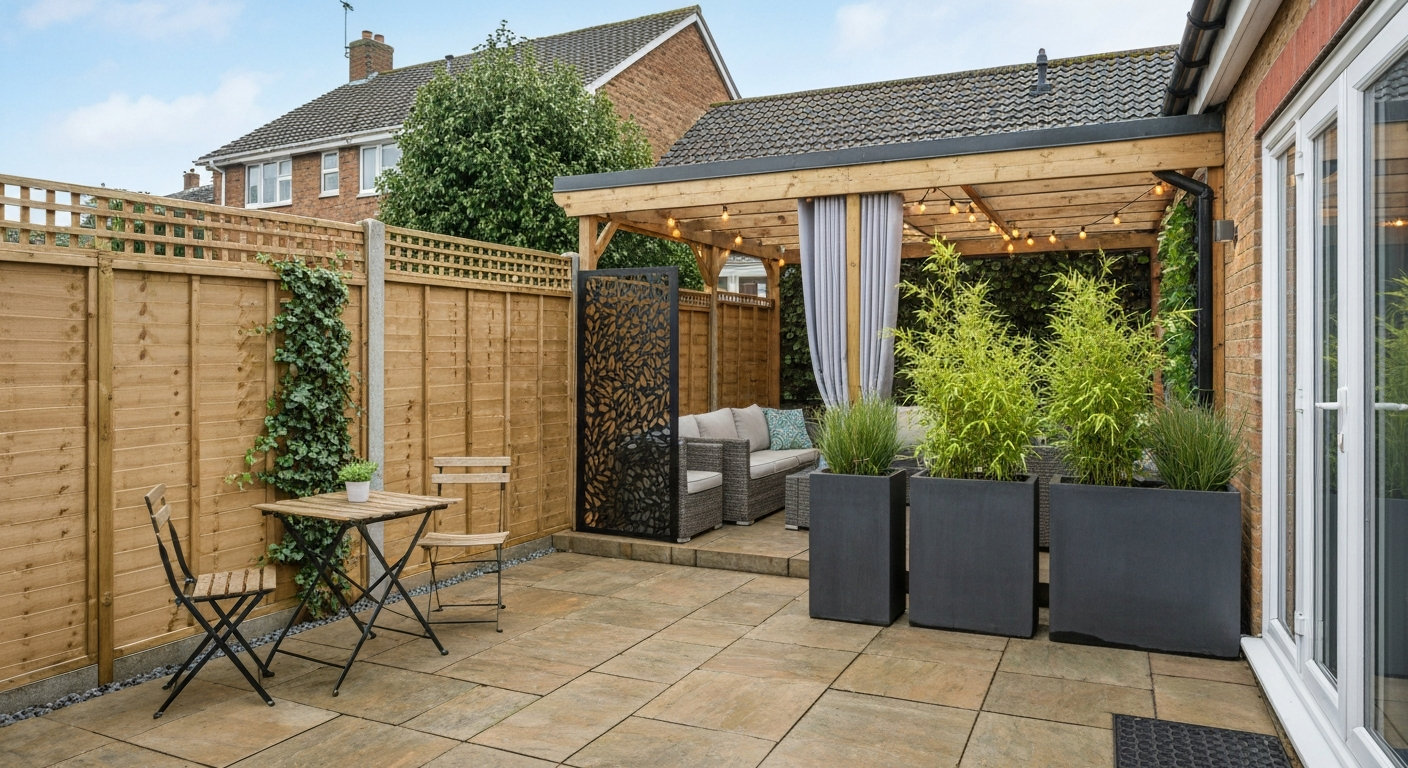
The most effective patio privacy ideas are privacy screens, solid timber or composite fencing, planted hedges, living walls, and pergolas with side panels, and the right one for you depends almost entirely on your patio size, budget, and how much permanence you want. If you're renting or working with a tiny urban patio, a freestanding screen or a row of tall planters can do the job in an afternoon. If you own a larger garden and want something that lasts decades, a close-board fence or planted hedge is hard to beat. This guide covers all the main options with honest costs, DIY steps, and notes for UK and temperate-climate readers.
Best Patio Privacy Ideas: Practical Guide for Homeowners

Phoebe Foster
28 Jul 2026
Who this guide is for
Whether you own a semi-detached in Manchester, rent a flat with a shared courtyard, or are updating a compact urban terrace, privacy on a patio is a genuinely common problem. This guide is written for homeowners and renters across the size spectrum, from small balconies and tight side-return patios to mid-size suburban gardens. There's specific coverage for UK and temperate-climate readers throughout, including plant species that actually perform in cooler, wetter conditions and notes on permitted development rules that affect what you can build without planning permission. If you're also looking for layout inspiration, related guides on small patio ideas and patio ideas pictures go deeper on the design side.
The best patio privacy ideas, ranked
Here's a quick overview of every solution covered in this guide, ranked roughly from most to least universally effective. 'Universal' means it works across most patio sizes, budgets, and climates, the deeper dives below explain when each one earns or loses points. For more inspiration and region-specific options, see our guide to the best patio ideas UK.
- Privacy screens: Fastest to install, works for renters and small patios, highly flexible.
- Solid fencing: Best all-round privacy performance, durable, suits most budgets with DIY.
- Pergolas with side panels: Adds overhead and side privacy together, improves the whole space.
- Planting and hedges: Slow to establish but low maintenance long-term, suits UK climates well.
- Living walls and vertical planters: Exceptional for tiny spaces, high visual impact, higher cost.
- Curtains and outdoor drapes: Cheap, renter-friendly, limited in wind and rain.
- Shade sails: Overhead privacy from above (neighbours' windows, overlooking floors), not lateral.
- Bamboo screening: Fast and affordable, requires root containment to avoid invasiveness.
- Trellis with climbers: Budget-friendly, natural look, slower to provide full coverage.
- Planter walls: Doubles as seating/storage, suits patios with no soil border.
- Privacy glass or frosted panels: Ideal for modern builds, balconies, and permanent installs.
Choosing by patio size
The single biggest mistake people make is choosing a solution that's scaled wrong for the space. A full-height close-board fence panel on a 2m x 2m courtyard patio creates a bunker. A flimsy 1.2m trellis on a large open patio does almost nothing. Here's a rough guide to what works at each scale.
| Patio size | Best privacy solutions | Solutions to avoid | Key consideration |
|---|---|---|---|
| Very small / balcony (under 6 m²) | Freestanding screens, vertical planters, privacy glass panels, outdoor curtains | Full-height solid fencing, large pergolas | Weight and fixing restrictions; wind loading matters more on elevated balconies |
| Small (6–20 m²) | Modular screens, compact pergola, trellis + climbers, bamboo in planters, planter walls | Wide living-wall installations (cost vs. area), sprawling hedges | Maximise vertical space; choose solutions that don't eat into floor area |
| Medium (20–50 m²) | Timber or composite fence, pergola with side panels, planted hedge, living wall feature wall | Shade sails alone (no lateral privacy) | Mix solutions: fence for boundary, planting for softness |
| Large (over 50 m²) | Close-board or featheredge fence, dense planted hedge, full pergola structure, combination approach | Freestanding screens only (not enough coverage) | Cost scales with perimeter; prioritise the sides facing neighbours or public spaces |
For very small patios and balconies specifically, the priority is solutions that fix to existing structures (walls, railings, fences already in place) rather than freestanding ones. Balconies in particular have load-bearing limits, so oversized planters or heavy stone features need structural checks. If you're working with a very tight footprint, the guide to best outdoor small patio ideas covers layout strategies that keep privacy solutions from overwhelming the space.
Privacy screens: the most flexible option
A privacy screen is any freestanding or wall-mounted panel designed to block sightlines. Materials range from powder-coated steel frames with woven resin, to solid timber slat panels, to laser-cut decorative metal. They're the go-to for renters because they don't require permanent fixing, and for small patios because they can be positioned exactly where you need them and moved when you don't.
Typical uses and configurations
- Freestanding panels (usually 1.5m–2m tall, 0.9m–1.8m wide) propped with weighted feet or spiked into soil
- Wall-mounted louvre or slat screens fixed to an existing fence or house wall
- Modular panel systems that link together to create a longer run
- Decorative laser-cut screens as a single focal-point panel rather than a perimeter solution
Pros, cons and costs
| Factor | Detail |
|---|---|
| Privacy level | High if solid; medium if louvred or slatted (adjustable louvres give the most flexibility) |
| Installation | DIY-friendly; freestanding versions require no tools beyond a mallet or drill |
| Cost (UK) | £40–£150 for a basic freestanding timber or resin panel; £200–£600+ for powder-coated steel or quality hardwood |
| Cost (US comparator) | Roughly $50–$300 for freestanding screens; custom fabricated panels $500–$2,000+ |
| Durability | Powder-coated steel: 15–25 years with minimal care. Untreated timber: 5–10 years. Hardwood or treated softwood: 10–20 years. |
| Wind performance | Freestanding screens are vulnerable in high winds; weighted bases or ground stakes essential. Check manufacturer wind-class ratings (BS EN 13561 applies to some screen/awning products). |
| Maintenance | Steel: annual wipe-down. Timber: re-oil or re-stain every 1–2 years. |
Small-patio adaptations
On a balcony or compact patio, fix a slim louvre screen directly to the existing wall or railing rather than using a freestanding version. A single 1.8m x 0.9m panel positioned at the corner where overlooking is worst gives you coverage without blocking airflow or taking up floor space. For a really tight balcony, frosted acrylic or polycarbonate screen panels are worth considering: they're lighter than timber, let light through, and attach to standard railing posts.
DIY steps vs when to hire
- Measure the gap or zone you want to screen and decide between freestanding, wall-mounted, or post-mounted.
- For freestanding screens: position weighted feet on a hard patio surface, or drive spike bases into soil at least 300mm deep.
- For wall-mounted: use masonry anchors for brick or blockwork walls (min. 60mm depth), check for cables or pipes before drilling.
- Link multiple panels using connector brackets or cable ties through the frame holes.
- Seal or treat timber immediately and reapply every season.
Hire a contractor if you're mounting a heavy steel or hardwood screen on a rendered wall, attaching to a shared party wall (which can trigger Party Wall Act obligations in England and Wales), or if the screen is over 2m tall and freestanding in an exposed garden where wind loading needs proper calculation. Designers use BS EN 1991‑1‑4 (Eurocode 1: Actions on structures, Part 1‑4 Wind actions) and the UK National Annex to assess wind loading and anchorage requirements for freestanding screens, pergolas and shade canopies BS EN 1991‑1‑4 (Eurocode 1: Actions on structures — Part 1‑4 Wind actions) and the UK National Annex.
Visual ideas and inspiration
- Horizontal cedar slat screen with 20mm gaps — blocks direct views while keeping airflow; suits modern and Scandi-style patios
- Black powder-coated steel frame with climbing plants trained through it — combines screen and living wall functions
- Decorative geometric laser-cut panel as a single feature behind a bistro table — suits small urban patios
- Bamboo roll screen attached to an existing fence top to add 0.5m of height cheaply
Fences: the classic high-privacy boundary
A solid fence is still the most reliable way to achieve full perimeter privacy. Done right, a good fence gives you decades of performance with minimal upkeep. The main choices are timber panels, featheredge/close-board, composite, metal, and concrete-post systems.
Types of privacy fence
| Type | Privacy level | Typical lifespan | Installed cost (UK per linear metre) | Notes |
|---|---|---|---|---|
| Timber panel (lapped) | High | 10–15 years (treated) | £25–£60 | Cheapest option; panels can bow or warp; replace individual panels easily |
| Close-board / featheredge | Very high | 15–25 years (treated) | £35–£80 | More robust than panel; wind performs better as boards flex slightly |
| Composite (wood/PVC) | Very high | 25–30+ years | £60–£120 | Low maintenance; higher upfront; UV stable; no rot |
| Metal (galvanised + powder-coated) | High (with infill) | 25–40+ years | £50–£100+ | Best longevity; hot-dip galvanised steel last decades per manufacturer data |
| Concrete gravel boards + timber posts | Medium-high | 20–30 years (posts) | £40–£90 | Concrete base prevents rot at ground level; common in UK gardens |
Privacy by fence height
A 1.5m fence gives seated privacy but anyone standing nearby can see over. 1.8m (6ft) is the standard UK garden privacy fence height and covers standing adults in most situations. Going above 2m requires planning permission in England and Wales under permitted development rules (or 1m if the fence borders a road used by vehicles, always worth double-checking with your local planning authority, especially in conservation areas or if an Article 4 direction applies in your area). In Scotland, Northern Ireland, and Wales, rules broadly follow similar logic but have separate regulations, so check locally.
Timber durability: what to look for
Timber for outdoor fencing is classified under BS EN 350 for natural durability. UK guidance from the British Woodworking Federation distinguishes between naturally durable species (such as western red cedar and oak, rated DC1–DC2) and lower-durability softwoods (pine, spruce) that require preservative treatment for ground-contact use. For fence posts in particular, always use pressure-treated timber rated for ground contact (Use Class 4 in UK/European classification) or set posts in metal spike or bolt-down bases to avoid ground contact altogether, which dramatically extends lifespan.
Small-patio fence options
On a small patio with an existing boundary, you often don't need a full new fence, you need a fence topper. A 300–600mm trellis fixed to the top of an existing 1.2m or 1.5m fence adds meaningful height cheaply, and climbers on the trellis give privacy without a solid top section that blocks light. Composite fence panels in half-width configurations (narrow vertical planks) also work well when floor space is tight.
Installation notes
- Check the ownership of the boundary fence before installing or modifying it — the deeds or title register will show who is responsible for which boundaries.
- In England and Wales, work on a party fence (shared with a neighbour) can trigger the Party Wall etc. Act 1996; you may need to serve written notice before starting work.
- Post spacing: standard 1.8m posts; don't exceed 2.4m spacing for timber panels or the fence will flex excessively in wind.
- Concrete post bases are stronger than timber in ground contact but take 48–72 hours to cure before tensioning panels.
- For DIY installation of standard panel fencing on a level site, a competent DIYer can install 8–10 panels in a day with one helper.
Pergolas and roofed structures: privacy overhead and to the sides
A pergola on its own doesn't give you privacy, it gives you structure. The privacy comes from what you add to it: side panels, curtains, climbing plants, or louvre roofs. That said, a pergola frames the patio in a way that changes how exposed it feels, and for patios overlooked from above (upstairs windows of a neighbouring property, flats, or raised ground), an overhead structure is the only real solution. Pergolas also double as shade and weather protection, making them one of the best value upgrades for a patio overall.
Building privacy into a pergola
- Side panels: polycarbonate, glass, composite slat, or timber — fixed or sliding
- Curtains or outdoor drapes: hung from the beam on rings, easy to pull back when not needed
- Climbing plants: trained over the sides and roof for a green, natural enclosure (slower but very effective long-term)
- Louvre roof: adjustable aluminium louvres give overhead privacy from above while controlling light and rain
Material comparison
| Material | Cost range (UK installed) | Lifespan | Maintenance | Best for |
|---|---|---|---|---|
| Pressure-treated softwood | £1,500–£4,000 | 15–20 years | Re-stain every 2–3 years | Budget builds, traditional gardens |
| Hardwood (oak, iroko) | £3,000–£8,000+ | 25–40 years | Oil every 2–3 years | Premium look, longevity |
| Powder-coated aluminium | £2,500–£7,000+ | 30+ years | Minimal — wipe down annually | Modern style, low maintenance, UK weather |
| Composite decking-style beams | £2,000–£5,500 | 20–30 years | Annual wash | Mid-budget, modern |
| Louvre system (aluminium) | £5,000–£15,000+ | 25–35 years | Annual inspection, clear drainage channels | Full weather/privacy control, premium install |
Airflow, light, and wind trade-offs
The more privacy a pergola gives, the less airflow it allows. A fully enclosed pergola with polycarbonate sides and a solid roof can feel stuffy in summer. In the UK, where the Met Office has documented increasing heatwave frequency, this is worth planning for. Adjustable louvre systems address this well: open the louvres in summer for ventilation, close them in rain or when privacy is needed. If you're using fabric curtains or shade sails as side panels, check wind ratings, products covered under BS EN 13561 (external blinds and awnings) will carry an operating wind class, and most are not safe to leave out in sustained winds above 38 km/h. Any freestanding pergola or attached structure should also account for local wind exposure; in exposed or coastal UK locations, post foundations and anchoring need to be adequate.
Small-patio pergola ideas
A lean-to pergola fixed to the house wall takes up far less footprint than a freestanding one and only needs two posts rather than four. For a really small patio (under 10m²), a 2m x 2m or 2m x 2.5m lean-to pergola with one or two curtain panels on the exposed sides achieves meaningful overhead and lateral privacy without overwhelming the space. Aluminium lean-to kits are widely available in the UK from £800–£2,500 in kit form, with professional installation adding £500–£1,500 depending on complexity. For compact spaces, see our guide to best small patio ideas for space-saving screening and layout tips.
Planting and hedges: the long-game solution
Planted privacy is the most natural-looking option and, once established, often the lowest maintenance. The trade-off is time: most hedging plants take 3–7 years to reach full screening height. For a UK garden, there are strong native and adapted options that cope well with cool, wet winters and increasingly warm summers.
Best plants for privacy screening (UK and temperate climates)
| Plant | Type | Growth rate | Eventual height | Notes |
|---|---|---|---|---|
| Western red cedar (Thuja plicata) | Evergreen conifer | Fast (30–60cm/year) | Up to 10m (clip to 2–3m) | Excellent UK performer; dense screening year-round; tolerates wet soil |
| Photinia 'Red Robin' | Evergreen shrub | Moderate (20–40cm/year) | 3–4m | Attractive red new growth; clips well; tolerates most UK soils |
| Griselinia littoralis | Evergreen shrub | Moderate-fast | Up to 8m (clip to 2m) | Excellent coastal/mild-climate choice; tolerant of wind and salt |
| Laurel (Prunus laurocerasus) | Evergreen | Fast (30–60cm/year) | Up to 8m (clip to 2m) | Very popular UK hedge; dense and cheap to establish; clip once or twice yearly |
| Bamboo (clumping species) | Evergreen grass | Fast | 2–5m depending on species | Only use clumping varieties or grow in large containers (see bamboo section) |
| Hornbeam (Carpinus betulus) | Deciduous (holds dead leaves) | Moderate | Up to 10m (clip to 2m) | Native UK species; retains brown leaves through winter giving partial screening |
| Yew (Taxus baccata) | Evergreen conifer | Slow (15–20cm/year) | Up to 10m | Longest-lived and most formal option; toxic berries — unsuitable with children/pets |
Spacing and small-patio planting
For a traditional in-ground hedge, plant laurel or photinia at 60–90cm spacing for a dense screen within 3–4 years. For small patios with no soil border, large half-barrel or cube planters (minimum 60 litres, ideally 100+ litres for anything over 1.5m tall) planted with compact upright shrubs, such as Sarcococca (sweet box), Viburnum tinus, or dwarf Thuja, give meaningful screening without ground planting. Water these more frequently than in-ground planting, particularly during hot summers. Drip irrigation on a timer makes container hedge maintenance much more manageable.
Seasonal performance and maintenance
Evergreen species give year-round screening, which is usually the goal for a patio. Deciduous hedges like hornbeam do hold their brown leaves through winter, providing partial cover, but they're not fully effective from November to April in the UK. Most formal hedges need clipping once in late summer (or twice for fast growers like laurel); this is a manageable DIY task for runs under 15m but worth hiring in for longer boundaries or tall hedges requiring ladders and access equipment.
Bamboo: a special case
Bamboo deserves a specific mention here because it's widely sold as a quick privacy screen but regularly causes problems when planted directly in the ground. The RHS distinguishes running bamboo (spreads aggressively via underground rhizomes) from clumping bamboo (stays in a manageable clump). Most fast-growing screening bamboos, Phyllostachys species in particular, are running types. If you plant them directly in the border without a root barrier, they will spread. The practical solution for a patio is to grow bamboo in large planters or raised beds with a solid base, which also means you can move or remove them if needed. Clumping species like Fargesia murielae and Fargesia robusta are well-suited to UK conditions and genuinely non-invasive.
Living walls and vertical planters: maximum impact, minimum floor space
A living wall is exactly what it sounds like: a vertical surface covered in growing plants. For privacy specifically, a fully planted living wall on the boundary side of a patio eliminates the fence-or-hedge dilemma, it's both. The visual effect is dramatic, especially in small urban spaces where a lush green wall replaces a blank brick or timber fence. The trade-off is cost and maintenance.
How they work
The RHS classifies green walls into three main types: green façades (climbers on a support structure), trellis systems (climbers on a fixed trellis), and modular living-wall systems (individual plant modules slotted into a frame, each with its own growing medium). For privacy purposes, all three work, but they differ significantly in cost, establishment time, and ongoing care. A simple green façade, ivy or climbing hydrangea on wire guides fixed to a wall, costs almost nothing beyond the plants and wires, but takes 2–4 years to cover a wall. A modular living-wall system is planted at full density from day one but costs significantly more and needs irrigation and regular maintenance.
Costs
UK cost data from local authority and specialist sources puts installed green façades (climbers on a frame) at roughly £282 per square metre and specialist modular living walls at around £702 per square metre. Ongoing maintenance for a modular outdoor living wall runs at approximately £30–£40 per square metre per year. These are not small numbers, a 2m x 3m (6m²) modular living wall could cost over £4,000 to install and £200/year to maintain. Simple climbers on a trellis are a fraction of that: a 2m x 3m trellis with plants might cost £150–£400 all-in as a DIY project, with minimal annual costs beyond occasional trimming.
Maintenance and what to expect
Modular outdoor living walls typically require monthly inspections and more intensive plant-care visits every 6–12 months, according to specialist providers. Many offer maintenance contracts for this reason. The RHS notes that modular systems have higher irrigation and plant-replacement needs than simple climber-based green façades. An integrated drip-irrigation system is essentially mandatory for a modular wall of any significant size, hand-watering is impractical and unreliable. Beyond privacy, living walls do deliver measurable benefits in noise reduction and thermal moderation, which is well documented in UK Green Building Council evidence, though these benefits are secondary to the privacy and aesthetic value for most homeowners.
Small-patio installs and modular options
For a small patio or balcony, modular pocket planters, the kind you fill with compost and hang on a grid frame, are a genuinely accessible starting point. A 1m x 1m grid of modular pockets costs £60–£200 depending on the system, can be wall-mounted using standard masonry fixings, and planted up with herbs, ferns, or compact perennials. This won't give you full privacy screening on its own, but combined with a trellis above or a screen to one side, it transforms the look of the space entirely. For renters, freestanding modular living-wall trolleys (basically a planter on wheels with a frame) are widely available and leave no permanent marks on the property.
Visual ideas for living walls
- Full-height Fargesia bamboo in a long trough planter along a boundary wall — dense, elegant, and manageable
- Modular pocket system planted with trailing ivy, ferns, and sedum on a sheltered urban patio wall
- Espalier fruit tree (apple or pear) trained flat against a south-facing fence — privacy, blossom, and fruit in one
- Mixed trellis with evergreen Clematis armandii and self-clinging Hydrangea petiolaris for a UK wall that covers quickly and looks interesting year-round
- Sleeper-edged raised planter built against a boundary with upright ornamental grasses and Miscanthus for a naturalistic screen
Quick decision checklist before you buy or build
Before you commit to any privacy solution, run through these questions. They'll save you time, money, and awkward conversations with neighbours.
- Privacy level needed: Do you need full visual screening or just a sense of enclosure? Full screening demands solid materials; a sense of enclosure can be achieved with trellis or planting.
- Patio size: Will the solution fit without eating into usable floor space? Check dimensions before ordering.
- Budget: What's the total spend including installation, not just materials? Factor in annual maintenance costs for plants and living walls.
- Permanence: Are you renting, or likely to move in the next few years? Prioritise movable or non-fixed solutions.
- Light and ventilation: Will a solid barrier create a dark, airless corner? Consider louvred, slatted, or planted options that allow some airflow.
- Wind exposure: Is the patio exposed? Freestanding screens and shade sails in exposed positions need proper anchoring and wind-class ratings.
- Local rules (UK): Check permitted development rules for fence height (2m general limit in England and Wales, 1m if adjacent to a vehicular highway). Conservation areas and listed buildings have stricter rules. Check before building anything structural.
- Shared boundaries: If the work involves a party wall or shared fence, check whether the Party Wall etc. Act 1996 applies and serve notice if required.
- Maintenance appetite: Are you willing to clip a hedge twice a year, oil a timber screen, or pay for a living-wall maintenance contract? Choose a solution that fits your actual schedule.
Curtains, shade sails, and the other options on the list
A few of the solutions in the ranked list deserve a brief note rather than a full deep-dive. Outdoor curtains (weighted, UV-resistant polyester or acrylic fabric hung from a pergola or wall-mounted rod) cost as little as £30–£80 per drop and are one of the best renter-friendly options, but they're weather-dependent. Most aren't suitable for sustained wind or heavy rain, and in the UK that's a significant limitation, always check BS EN 13561 wind-class ratings on the product, or take them down in winter. Shade sails address overhead privacy (from upstairs windows, for example) rather than lateral privacy; they're excellent when that's the actual problem, but they do nothing to screen you from a neighbour at the same level. Trellis with climbers is one of the best-value long-term options: a 1.8m pressure-treated trellis panel costs as little as £15–£30, and climbing plants like Clematis montana or the evergreen Clematis armandii will cover it within 2–3 seasons in a UK garden. Privacy glass (frosted or patterned structural glass panels) is the most permanent and modern-looking option, common in new builds and contemporary patio upgrades, but at £150–£400+ per panel plus fixing costs, it's a considered purchase. Planter walls, rows of large cube or trough planters stacked or arranged as a room divider, are a great mid-budget option for patios with no soil border, work equally well on hard surfaces, and can double as seating edges or display space.
Putting it all together: what actually works
The most effective patio privacy setups usually combine two solutions rather than relying on one. A solid fence or screen for immediate screening, with planting in front to soften it and add depth. A pergola for overhead coverage, with curtains or slat panels on the exposed side. A living wall for visual impact on the dominant overlooked face, with a simple trellis to either side. The approach you take will depend on your budget, how permanent you want it to be, and whether you're gardening in a UK terrace, a suburban garden, or a small balcony. Start with the biggest privacy problem, usually one specific sightline or overlooked direction, and solve that first before adding layers. That's always been the most practical way to approach it, and it stops you overspending on a solution that looked good on paper but didn't address the actual issue.
FAQ
Which patio privacy solutions are most effective overall and how are they ranked for homeowners and renters?
Top-ranked solutions by effectiveness, flexibility and suitability for a range of patios: 1) Fencing / timber panels – strong visual/physical barrier, good for permanent privacy. 2) Freestanding privacy screens (wood/metal/composite) – flexible, renter‑friendly. 3) Trellis with climbers – low cost, natural look, good for gradual coverage. 4) Planting / hedging – attractive and long‑term but takes time to establish. 5) Living walls / modular green walls – high visual impact, higher cost and maintenance. 6) Pergolas with side screens/roofing – combines shade and privacy. 7) Privacy curtains / outdoor fabric – very flexible and portable. 8) Shade sails – good overhead privacy and shade, limited lateral screening. 9) Bamboo (in planters) – fast screen if clumping species used and contained. 10) Planter‑walls (raised planters with slats) – dual structure + planting. 11) Privacy glass / frosted panels – modern look, permanent and weatherproof. 12) Composite or metal mesh panels – durable, modern aesthetic. Choice depends on permanence desired, budget, landlord permission and space constraints.
How do I choose the right solution for a small patio? Any adaptations that work particularly well?
Small patios benefit from solutions that save floor space and preserve light: - Use vertical screening (trellis, climbing plants, living-wall modules, narrow planter‑walls) rather than tall bulky structures. - Lightweight, foldable or freestanding screens and outdoor curtains allow flexible arrangements and storage. - Transparent or semi‑opaque privacy glass and slimline metal slatted panels maintain openness while screening sightlines. - Choose narrow, tall planters (cantilever planters) or layered planting to provide greenery without crowding seating. - For renters, removable options (planter screens, tension‑mounted curtains, freestanding panels) give privacy without permanent fixtures. - Keep circulation and sunlight in mind: avoid overscreening that makes a small patio feel cramped; prefer partial screening (1.2–1.6 m) to retain air/visual connection.
What UK/temperate‑climate considerations should influence my choice (wind, sun, moisture)?
Key UK/temperate considerations: - Wind: many patios are exposed; choose wind‑rated products and secure anchorage. Standards like Eurocode BS EN 1991‑1‑4 guide structural wind assessment for freestanding screens, pergolas and shade canopies. Use wind‑rated awnings/awnings manufacturers’ wind classes (BS EN 13561). Solid tall screens can act as sails—anchor or avoid in very exposed sites. - Sun and heat: hotter summers increase UV and heat exposure. Use UV‑resistant fabrics and select plants tolerant of summer heat and intermittent drought (consider Met Office trend toward hotter, drier summers). - Moisture and rot: in wet climates, select rot‑resistant woods (treated timber, naturally durable species per BS EN 350), metal with good galvanisation and powder‑coating, or composite materials. - Salt/coastal exposure: choose stainless or hot‑dip galvanised metals and marine‑grade fixings. - Plants: prefer species suited to temperate UK conditions; for living walls, allow irrigation and frost‑tolerant planting strategies.
What are typical cost ranges (ballpark) for the main solutions in the UK?
Estimated UK ballpark costs (installed where noted) — ranges vary by size, finish and locality: - Timber fence panels: material + installation ~ £25–£60 per linear metre (standard panel guidance ~ £45 per panel installation). - Metal/steel panels or gates: £50–£150+ per linear metre installed depending on finish (galvanised + powder coating costs more). - Freestanding screens: £30–£300+ per unit depending on material/height; DIY cheaper. - Trellis with climbers: trellis £10–£60/m²; planting additional. - Living wall systems: modular living walls ~ £500–£1,000+/m² installed for specialist systems (local case studies report averages; green façades cheaper — e.g., green façade ≈£282/m² CAPEX vs specialist living walls ≈£702/m² from local authority summaries). - Planter‑walls / raised planters with slats: £100–£600+ depending on size and materials. - Privacy glass panels: £150–£500+ per panel installed depending on glass type and supports. - Pergola (basic) with side screens: £600–£4,000+ depending on size, materials and roof type. - Shade sails: £50–£400+ for panels; installation/anchorage extra. - Bamboo (in planters): plant cost low (£20–£100+), but containment/root barriers add cost. Maintenance contracts (living walls) commonly £30–£40/m²/year; fencing maintenance/repair costs variable. Use local quotes for accuracy and always check suppliers’ warranties.
How do materials compare — pros, cons and longevity expectations?
Timber: pros — warm look, relatively inexpensive, easy to DIY; cons — needs preservative treatment, rot/decay risk in wet climates; longevity depends on species/treatment (treated timber can last 10–20+ years; BS EN 350 classifications guide choices). Metal (galvanised/powder‑coated steel, aluminium): pros — durable, low maintenance, long warranties (metal systems often 15–25 years); cons — costlier upfront, potential corrosion if coatings fail; choose hot‑dip galvanised for longevity. Composite (wood‑plastic): pros — low maintenance, rot‑resistant; cons — more expensive, colour may fade. Glass (frosted/privacy glass): pros — modern, durable, easy to clean; cons — fragile, needs good framing, privacy only where mounted. Fabrics/curtains/shade: pros — flexible, inexpensive, renter‑friendly; cons — UV fade, need seasonal removal/cleaning; expect 3–7 years for outdoor fabrics depending on quality. Living walls/green façades: pros — aesthetic, biodiversity, cooling/noise benefits; cons — highest maintenance and CAPEX, need irrigation; modular systems may need monthly checks and 6–12 monthly servicing. Bamboo: pros — fast growth, dense screen in planters; cons — invasive if running types not contained; use clumping species or root barriers. Plastic/vinyl fencing: pros — low maintenance; cons — can look cheaper, can crack in cold/UV over time.
What are straightforward DIY steps and low‑cost alternatives? When should I hire a contractor?
DIY/low‑cost options: - Freestanding screens: buy or build simple timber or pallet screens, anchor with weights/planters. - Trellis + climbers: install trellis panels against walls or on posts and plant fast‑growing climbers (honeysuckle, clematis, ivy where appropriate). - Planters with tall plants: use narrow planters and tall species for portable screens. - Outdoor curtains: install tension rods, ceiling track or post hooks and hang weatherproof curtains. - Shade sails: buy pre‑cut sails and fix to existing posts/walls with proper anchors. Basic tools and local hardware suffice. When to hire a contractor: - Permanent fencing requiring foundations, close to neighbours (party wall issues), or over 2 m where planning/permits may apply. - Installing freestanding structures requiring structural anchorage (per Eurocode wind loading) or when using heavy glass/metalwork. - Living wall installations with irrigation systems and specialised mounting. - Pergolas with roofs or complex joinery/roofing. - Where ground conditions or retaining walls are involved. Contractors also help obtain any necessary permits and provide warranties.
Next Articles
Best Small Patio Ideas: Layouts, Materials, and Upgrades
Space-saving small patio layouts, materials, upgrades, DIY vs pro tips, and common mistakes to avoid.
Best Outdoor Small Patio Ideas: Layouts, Upgrades, Tips
Best small patio ideas with layouts, upgrade comparisons, and placement tips for privacy, shade, lighting, and comfort.
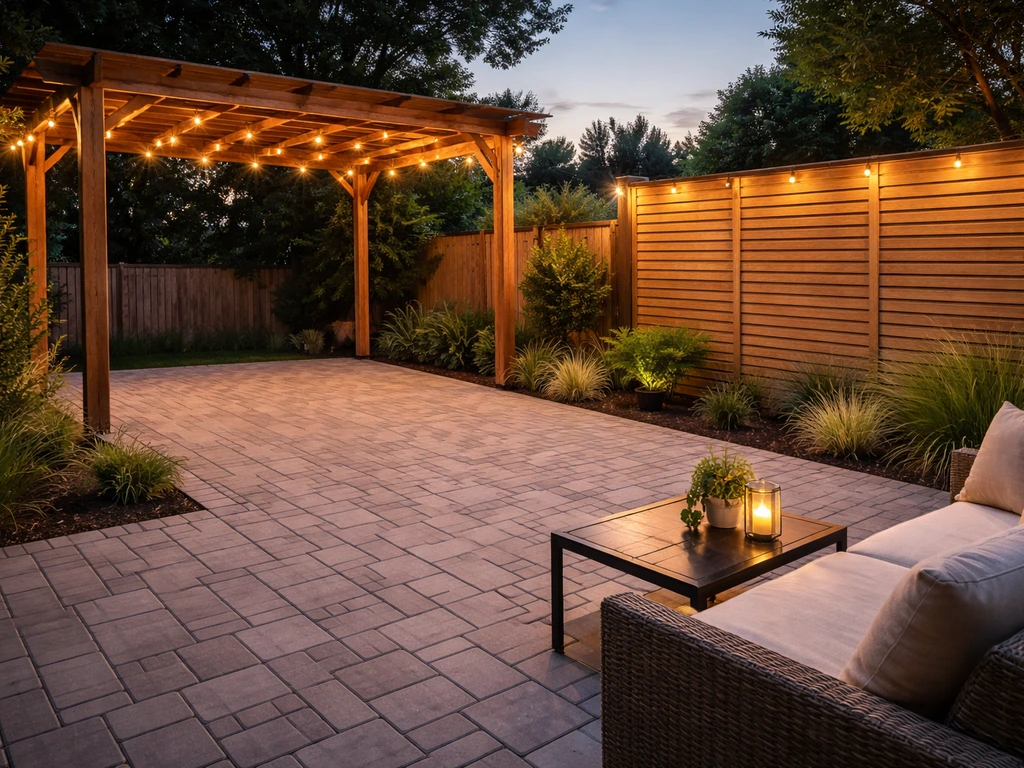
Do It Yourself Outdoor Patio Ideas: Build, Upgrade, Maintain
DIY outdoor patio ideas for planning, building, upgrading, and maintaining floors, shade, privacy, lighting, and decor.