
Finding the best patio installer near you comes down to three things: being specific about what you want built, screening contractors against a short checklist before you ever talk price, and comparing itemized quotes so you're not choosing blind. Get those three steps right and you'll hire someone who builds a patio that lasts decades, not one that cracks, sinks, or drains toward your house.
Best Patio Installers Near Me: How to Choose Locally

Phoebe Foster
15 May 2026
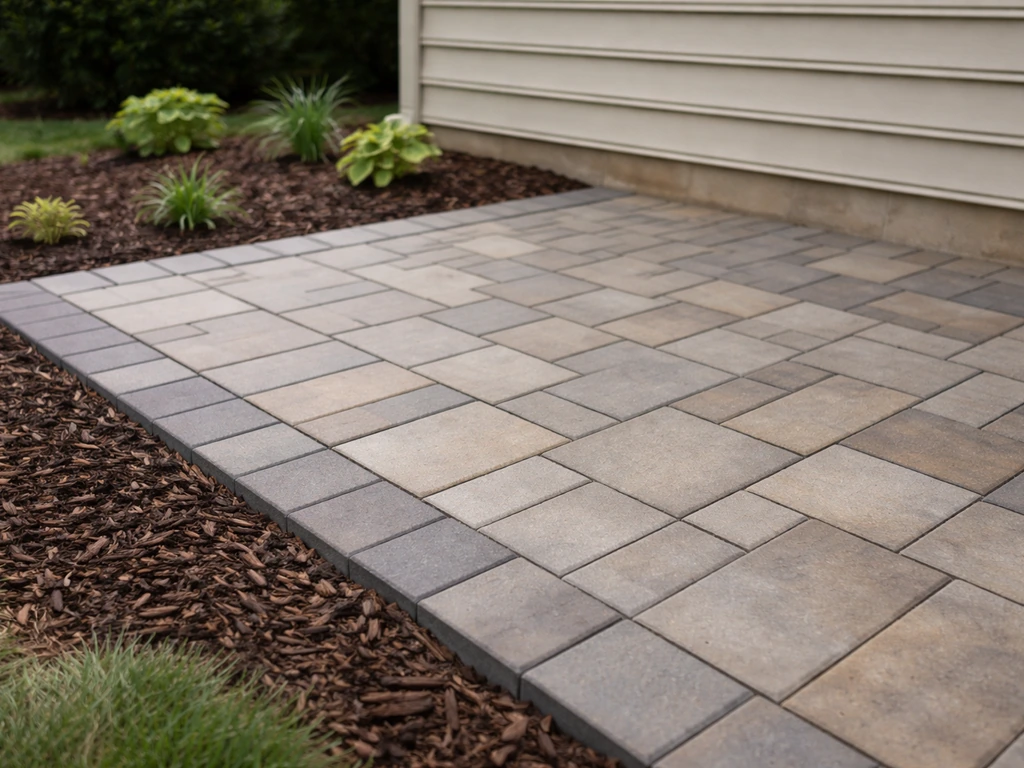
Define your patio project before you call anyone
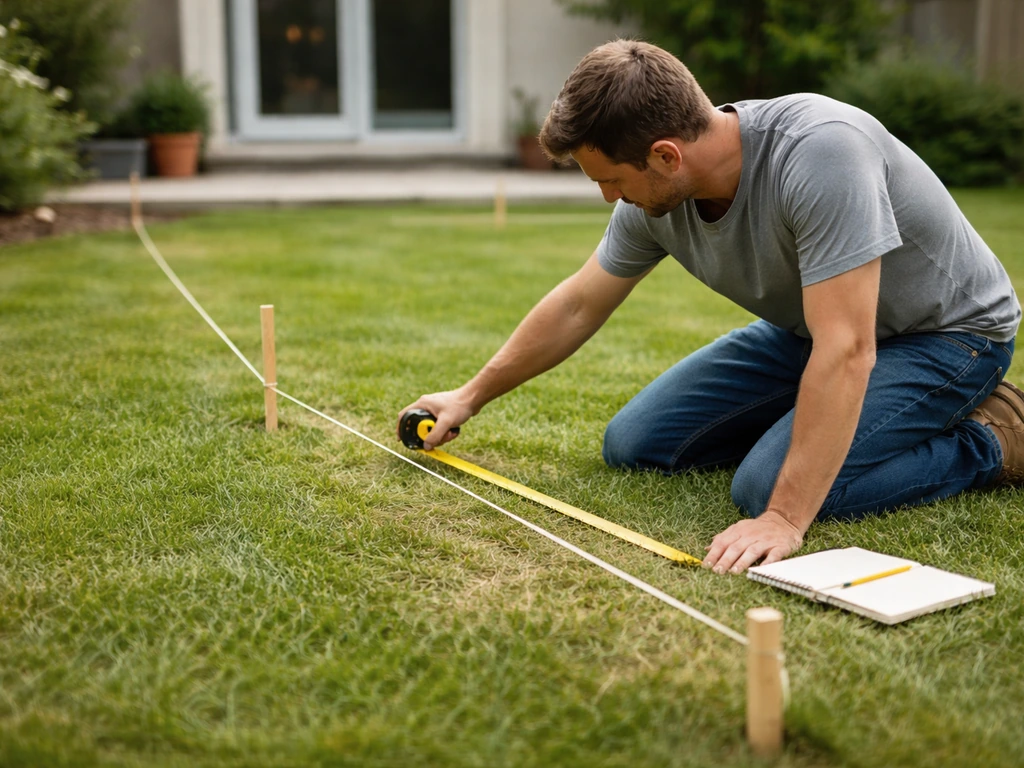
The single biggest mistake homeowners make is calling contractors before they know what they want. You don't need architectural drawings, but you do need to answer a few basic questions, because the answers change who you hire.
First, is this a new patio or a replacement? Replacement projects require demolition and haul-away, which adds cost and affects which contractors will even take the job. Second, what's your rough size? A 200-square-foot patio and a 600-square-foot patio are almost different projects in terms of materials, base prep, and drainage planning. Third, what material do you want?
- Concrete (poured): durable, cost-effective, customizable with stamps or stains, but requires proper air entrainment (4–7% air content) in freeze-thaw climates to prevent spalling
- Concrete pavers: modular, repairable, strong visual appeal, require a compacted aggregate base (minimum 6–8 inches of stone), 1-inch bedding sand, edge restraints, and geotextile fabric to keep soil from contaminating the base
- Natural stone (flagstone, bluestone, travertine): high-end look, variable thickness requires skilled setters, slippery when wet unless textured
- Brick pavers: classic look, frost-tolerant if properly installed, similar base requirements to concrete pavers
- Composite or porcelain tile: trending for modern designs, requires very flat and stable bases, can be slippery without anti-slip rating
Beyond the surface material, think about features. Do you want a patio cover, pergola, shade sail, or full enclosure built alongside the patio? If you want a screened-in or fully enclosed patio, focus on companies that routinely build enclosures that match your climate and drainage needs patio enclosures. What about misters, ceiling fans, or outdoor lighting? Are you planning raised sections, steps, built-in seating walls, or fire pit areas? The more completely you describe your project, the more accurate and comparable your quotes will be. Contractors who also handle covers, enclosures, and landscaping integration exist, but not all patio installers do all of these things, so knowing your scope upfront helps you find the right specialist.
Where to find top patio installers nearby
There's no single magic directory, but a few sources consistently surface quality local contractors faster than others. If you want faster results, you can also shortlist options using best patio landscapers near me and then vet them with the checklist in the next section. If you're searching for the best deck and patio contractors near me, focus on installers who have relevant portfolio photos and verified licensing and insurance find top patio installers nearby. Using the steps above helps you narrow down the best patio contractors for your project type and climate.
Google is still the fastest starting point. Search your specific project type, like 'paver patio installer [your city]' rather than just 'patio installer,' and look at the Google Business profiles carefully. Businesses showing up in Google Local Services Ads have gone through a verification process that includes background checks and, for applicable trades, proof of a valid certificate of insurance. That's a basic filter already applied for you.
HomeAdvisor (now part of Angi) and Houzz both have contractor networks where business owners and principals go through background checks as part of the screening process. These aren't deep vetting processes, but they weed out some of the worst actors. Nextdoor is genuinely useful for hyperlocal referrals because neighbors in your actual neighborhood have used these contractors and dealt with local soil, drainage, and climate conditions. Ask specifically: 'Does anyone have a concrete paver patio or stamped concrete patio installed in the last two years? Who did you use and would you hire them again?'
Manufacturer referral networks are underused and often excellent. Paver manufacturers like Techo-Bloc and Belgard maintain lists of certified or preferred installers who've been trained on their specific products and installation standards. If you've already picked a paver line you like, starting with the manufacturer's installer finder gets you someone who knows the product inside out.
Local landscape supply yards and hardscape material distributors also know who the good installers are, because they see who buys quality base materials and who cuts corners. If you have a local masonry or landscape supply company nearby, walk in and ask who does nice paver or stonework in the area. That conversation takes five minutes and is often the best lead you'll get.
How to vet contractors before you let them quote
Vetting before the quote saves you a lot of wasted time. Here's the short checklist to run through on every contractor before you schedule a site visit.
License verification

Licensing requirements vary by state, but most states have a searchable contractor license database. California's Contractors State License Board has a public 'Check a License' tool where you enter the license number and instantly see active or suspended status. Georgia's Secretary of State site has a similar lookup for residential and general contractors. Oregon's Construction Contractors Board (CCB) publishes full licensing records and explains that licensed contractors must carry workers' compensation insurance if they have employees, plus valid public liability and property damage coverage shown via a certificate of insurance. Whatever state you're in, take 90 seconds to look up the license number the contractor gives you. Don't take their word for it.
Insurance requirements
Ask for a certificate of insurance showing general liability and workers' compensation before anyone sets foot on your property. General liability protects your home if a contractor damages your fence, window, or landscaping. Workers' comp protects you from being personally liable if a worker gets injured on your property. A legitimate contractor sends this without hesitation. If they stall or offer excuses, that's a hard stop.
Experience with your specific patio type
A contractor who mostly pours concrete driveways is not automatically a great paver installer, and vice versa. Ask specifically how many projects they've completed that match yours: same material, similar size, similar features. Ask to see photos or visit a completed job. Portfolio quality tells you a lot, but the real test is asking to contact a past client who had a similar project done 12 to 24 months ago, so you can ask about how the patio held up through weather cycles.
Process and timeline
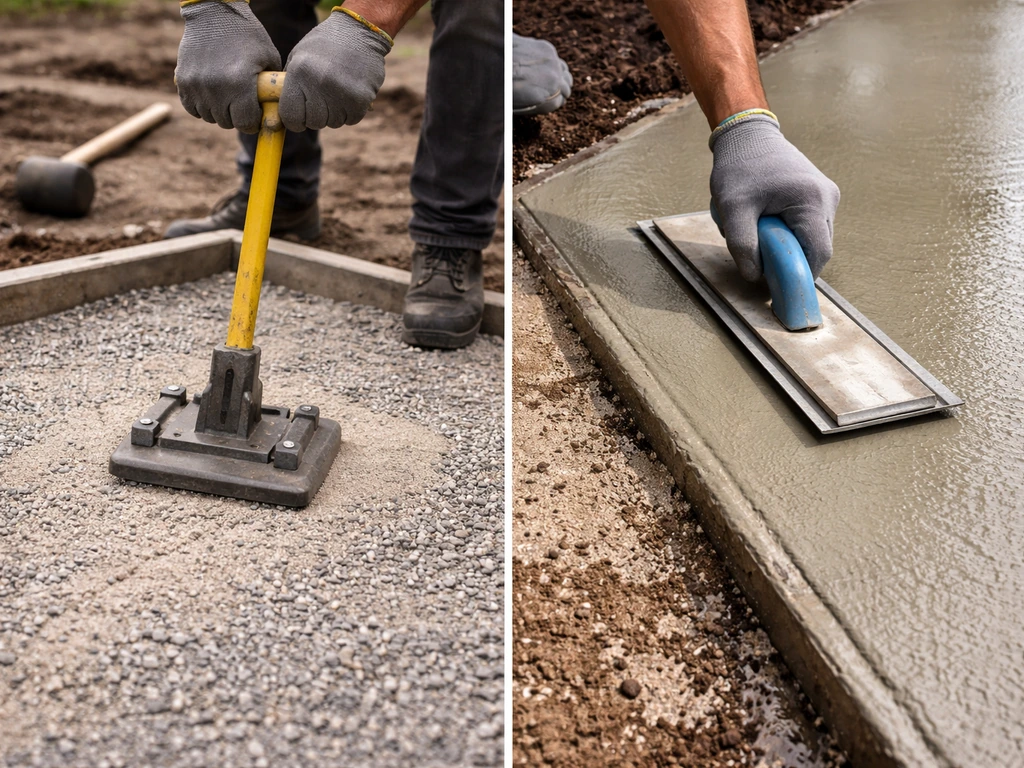
A knowledgeable installer should be able to walk you through their installation sequence without prompting. For pavers, that means: site layout and excavation, compaction of the subgrade, geotextile fabric installation, aggregate base placement and compaction (not less than 6–8 inches for a patio), bedding sand screeded to a nominal 1-inch thickness, paver placement, edge restraints, plate compaction of the installed pavers, and joint sand filling. For concrete flatwork, they should talk about subgrade prep, proper base thickness, reinforcement placement, pour timing, finishing, and curing method. If they can't explain their process clearly, they either don't have a solid one or they aren't going to be great at communicating with you throughout the project.
How to compare quotes the right way
Get at least three quotes, ideally four. A single quote gives you no context. Two quotes creates a false binary. Three or four quotes let you see the market clearly and spot outliers in both directions.
The most important thing to ask for is an itemized quote, not a single lump-sum number. When quotes are itemized, you can compare apples to apples. Here's what each quote should break down:
| Line Item | Why It Matters |
|---|---|
| Demolition and haul-away (if applicable) | Some contractors lowball the base quote and add this as a surprise later |
| Excavation and subgrade preparation | Depth and compaction method should be specified; shortcuts here cause settling |
| Base aggregate (type, depth, compaction method) | At least 6–8 inches of compacted stone base is standard for residential patios |
| Geotextile fabric | Prevents soil contamination of the base; should be listed if applicable |
| Bedding sand (for pavers) | Nominal 1-inch screeded layer; should be spec'd in the quote |
| Surface material (brand, product, quantity) | Allows you to verify you're comparing the same product tier |
| Edge restraints | Essential to hold pavers and prevent spreading; sometimes omitted by cheap contractors |
| Labor | Should be broken out from materials so you can see cost structure |
| Drainage provisions | Swales, drainage pipes, or slope specs; especially important in low-lying areas |
| Permits and HOA filing fees | Who pulls permits and who pays for them should be explicitly stated |
| Sealing or finishing treatment | Is a sealer included or is it an add-on? What product, what timeline? |
| Cleanup and site restoration | What happens to your lawn, plantings, and driveway after the job? |
When you have itemized quotes from multiple contractors, you'll often find that the cheapest overall bid is cutting corners on base depth, skipping edge restraints, or omitting drainage work. That's not a deal, that's a patio that fails in three years. Pay attention to what's in each quote, not just the bottom line.
Also ask every contractor about their change-order policy in writing before you sign anything. Change orders are how costs balloon mid-project. A good contractor defines what triggers a change order, how pricing is determined, and requires your written approval before proceeding with any out-of-scope work.
Questions to ask before you hire anyone
These are the questions worth asking on your first call or at the site visit. The answers reveal competence and professionalism faster than anything else.
- Are you licensed and insured in this state, and can you send your certificate of insurance today?
- How many patio projects similar to mine have you completed in the last 12 months?
- Can I see photos of a completed project in my neighborhood or with similar soil and drainage conditions?
- Can I speak to or visit a past client who had a similar patio installed 12 to 24 months ago?
- What is your base prep process, and how deep will you excavate and compact?
- Who pulls the permit, and is that cost included in your quote?
- Do you use geotextile fabric under the base? (For paver projects, this is a good indicator of quality.)
- What is your drainage plan for this specific site?
- What is your timeline from start to finish, and do you do the work yourself or subcontract it?
- What warranty do you offer on labor, and what does it cover specifically?
- What is your change-order process, and will you get my written approval before proceeding?
- What does your payment schedule look like, and what percentage is due upfront?
Never pay more than 10–15% upfront, and be cautious of anyone asking for 50% or more before work starts. A staged payment schedule tied to project milestones (excavation complete, base complete, surface material installed, final walkthrough) is the right structure.
Red flags, warranties, and what to expect on install day
Red flags that should stop a hire
- No physical address, no license number, or won't send insurance documentation
- Quote is verbal only, with nothing in writing
- Pressure to sign immediately or lose a 'special price'
- Large upfront payment request (more than 15–20% of total)
- No portfolio, or portfolio photos are vague and can't be verified
- Can't name a single past client willing to be contacted
- Lump-sum quote with no itemization when you ask for it
- Promises a timeline that sounds too fast for the scope (a 600-square-foot paver patio done in one day is a red flag)
Warranties: what to look for
Reputable patio installers typically offer a one to five year labor warranty on hardscape work, covering settling, cracking, or joint failure that results from their workmanship rather than acts of nature. Paver manufacturers often have separate product warranties. Ask for both in writing and read what's excluded. A warranty that only covers full replacement if every paver from a discontinued line is still available is essentially worthless. A good warranty specifies the repair or replacement process and timeline for response.
What to expect during installation
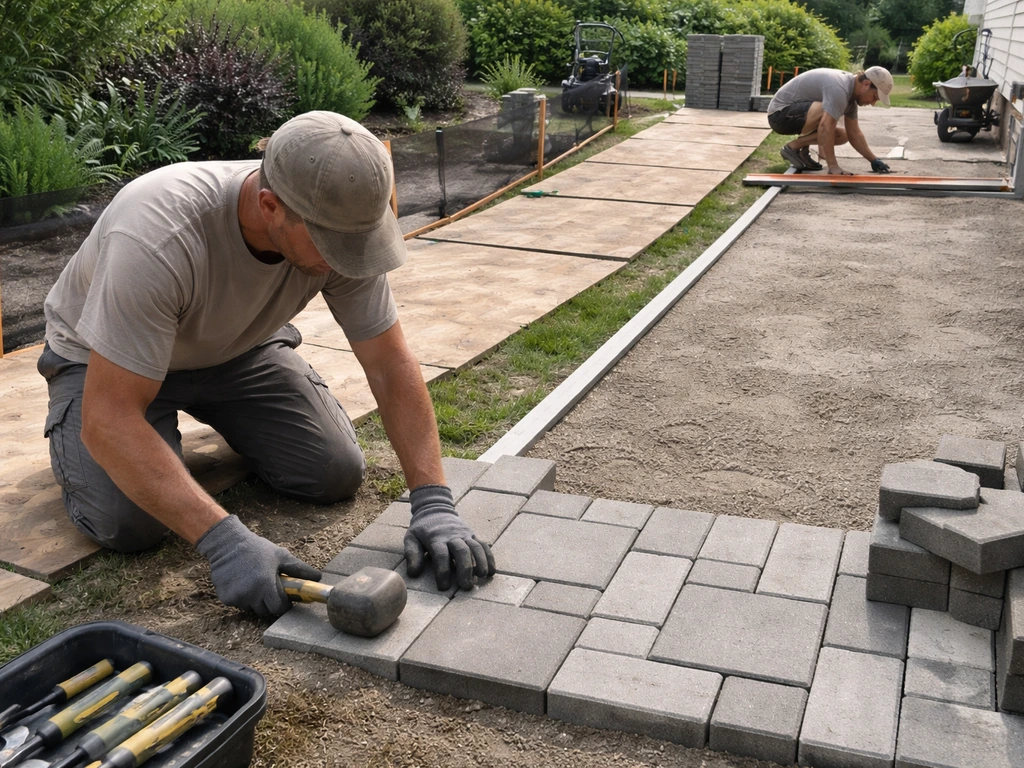
A professional crew will arrive when they say they will, protect existing landscaping and hardscape with barriers or plywood paths, communicate daily about progress, and not leave your yard in chaos overnight without reason. For paver installations, you should see them compact the subgrade, verify base depth, screed the sand bed carefully, and use a plate compactor after pavers are set before filling joints. For concrete work, they should discuss curing method upfront. Proper concrete curing means maintaining moisture and temperature above 50°F to allow the concrete to develop full strength. Most contractors start sealing around 7–14 days, but concrete benefits from a full 28-day cure before sealing. For exterior freeze-thaw applications, specify air-entrained concrete (4–7% air content) when you review the mix design with your contractor.
Regional and climate factors that change how you hire
Where you live genuinely changes what a well-built patio looks like and which contractors are qualified to build it. This is one area where local experience matters enormously.
Cold climates with freeze-thaw cycles (Midwest, Northeast, Mountain West)
Freeze-thaw is the leading cause of patio failure in cold climates. For concrete, air entrainment at 4–7% air content is non-negotiable. For pavers, the base depth matters more here than anywhere else because frost heave pushes up improperly prepared bases. Ask contractors in these regions specifically about frost depth in your area and whether their base depth accounts for it. Drainage is critical too: water trapped under a base will freeze, expand, and wreck the surface above it. Ask about perforated drainage pipes with surrounding open-graded stone wrapped in geotextile, especially for patios near the house foundation or in low-lying areas.
Hot, arid climates (Southwest, Texas, Southern California)
Heat and UV exposure degrade sealers and certain surface materials faster in these climates. Ask contractors what sealer products they use and how often reapplication is needed. Porcelain tile and natural travertine handle heat well but can be dangerously hot underfoot in full sun without a shade structure. In Texas especially, clay soils shrink and expand seasonally, which means base compaction technique and geotextile fabric are critical to prevent differential settling. If you're also looking at a cover, pergola, or misting system, it's worth finding a contractor who coordinates all of that rather than piecing it together later.
Humid and high-rainfall regions (Southeast, Pacific Northwest)
In the Southeast and Pacific Northwest, drainage design is as important as the surface material. A patio that holds standing water will grow algae, develop efflorescence in paver joints, and eventually cause settling. Ask contractors about slope specifications (a minimum of 1% slope away from the house is standard, and 2% is better in heavy rain zones). Ask how they handle drainage at the perimeter. For paver projects, sealers in these climates must be breathable to allow moisture to move through and evaporate, not trap it. Ask what sealer product they use and whether it's vapor-permeable.
Wind-prone areas and HOA considerations
If you're adding a patio cover or pergola alongside the patio itself, wind load matters a lot in coastal areas or open plains. Contractors handling both the patio surface and overhead structures need to understand local wind speed requirements and building code. Many HOAs also require permit approval for patio covers even if your municipality doesn't. Ask your contractor directly who handles the HOA submission and whether it's been done in your neighborhood before.
Your action plan for today
Here's exactly what to do right now if you're serious about moving forward.
- Write down your project scope: new vs replacement, approximate square footage, surface material preference, and any features (cover, fans, lighting, steps, seating walls)
- Search Google for '[your material type] patio installer [your city]' and note the top 5 results with Google reviews above 4.5 stars and at least 20 reviews
- Check Nextdoor for neighbor recommendations for similar patio types completed in the last 24 months
- Verify the license number for each contractor on your state's licensing board website before scheduling any visits
- Request certificates of insurance from your top 3 or 4 candidates before scheduling site visits
- Contact each contractor and ask the key questions listed above during the first call to eliminate unqualified candidates before wasting time on site visits
- Schedule site visits with your top 3 candidates and ask each for a fully itemized written quote
- Compare quotes using the line-item breakdown table above, not just the total price
- Ask for one past client reference per contractor and actually call them
- Choose the contractor who combines reasonable price, clear process, verified license and insurance, relevant experience, and a written warranty
If you're also planning a patio cover, enclosure, deck integration, or landscaping around the patio, it's worth checking whether your installer handles those elements or whether you'll need additional specialists. When you do that, you can compare the best patio cover installers for your exact cover type and climate needs. If you want help choosing the best patio cover companies near me, start by checking they have recent installs for your specific cover style and climate. Some homeowners find it easier to work with a full-service outdoor contractor who coordinates everything, while others prefer to hire the best specialist for each element separately. Either approach works, but coordinate the sequencing carefully so the patio surface goes in after any major structural footings are set.
The whole process from first search to signed contract can realistically take two to three weeks if you move efficiently. Don't rush the vetting phase to save a few days. The difference between a patio that looks great after ten years and one that needs a full reinstall after four usually comes down to who built it and how carefully they prepped the base.
FAQ
Can I trust a low patio installer quote if the scope is “similar” but not exactly the same as my design?
Yes, but only if you can get specific details in writing. Ask whether the bid assumes removal of existing concrete, hauling fees, and whether the contractor will match elevation to your doors and drainage path. If they cannot clearly state what is included for demolition and disposal, the “cheap” quote often reappears as change orders later.
How do I confirm they actually specialize in my patio material, not just general hardscapes?
Not necessarily. Many contractors will reference “experience” but not project counts for your exact material. Ask for a breakdown like, “How many paver patios of 300 to 700 square feet have you installed in the last 12 months, and how many were over clay soil or in freeze-thaw areas?” This forces relevant experience rather than generic resumes.
Who should handle my patio cover permits and HOA approval, the installer or me?
If there is an HOA or city review, you want permits handled before construction starts. Ask for the permit plan set process, typical timeline, and whether they have previously built the same patio cover or enclosure type in your neighborhood. If they say “we’ll submit if needed” without naming who submits, that is a red flag.
What should I ask about concrete curing and sealing timelines?
A concrete curing timeframe depends on temperature, mix, and finish schedule. Ask for their curing method (for example, curing compound versus wet curing), their target days before seal and before heavy foot traffic, and what they do if rain is forecast during the cure window. For exterior pours, insist on clear weather controls and rescheduling rules in writing.
What jobsite protections should a patio installer provide so my yard and landscaping are not damaged?
Do it. Ask the contractor for confirmation of jobsite protection, including dust control, access paths, and how they prevent slurry or paver sand from washing into drains. For nearby landscaping, require protection plans like plywood walkways and material staging locations, especially if your patio is close to foundations or irrigation lines.
What details matter most in a patio labor and materials warranty?
Ask for a warranty that names what failures are covered, what is excluded, and what “response time” means. Also ask whether labor is covered separately from materials, and whether they offer repair versus full replacement as the first option. A warranty that only applies after total collapse is usually not worth much.
How do I spot “apples to apples” vs hidden scope differences across itemized quotes?
Yes, you can treat extra costs as scope gaps. Compare line items for base depth, edge restraints, geotextile type, drainage components, joint sand, and any sealing. If one bid is missing “drainage at perimeter” or “geotextile fabric,” you are not comparing the same job, even if the surface material looks identical.
What change order policy questions should I ask to prevent cost spikes?
Yes, and it should be written before work begins. Ask them to define triggers like design changes, unanticipated base conditions, rock removal, drainage revisions, or permit-driven changes. Then ask how pricing is calculated (labor rates, unit pricing, or percentage add-ons). If you cannot get a clear policy and example change order, do not sign.
Do I need to worry about bonding to an existing patio, deck, or walkway extension?
Often it is, especially if the patio is near decks, fences, or foundation walls. Ask whether they will evaluate settlement risks, provide a plan for slope and runoff direction, and use transition details for steps or abutting surfaces. Also ask if their base prep includes compacted subgrade and how they handle tie-ins to existing structures.
Should I ask for quality checkpoints during the install, like base and compaction verification?
Ask when they will schedule inspections or verification steps, for example base depth verification, compaction checks, and final joint sand confirmation. If they do not mention these quality checks, you can request a simple sign-off checklist at each stage before they move on.
Next Articles
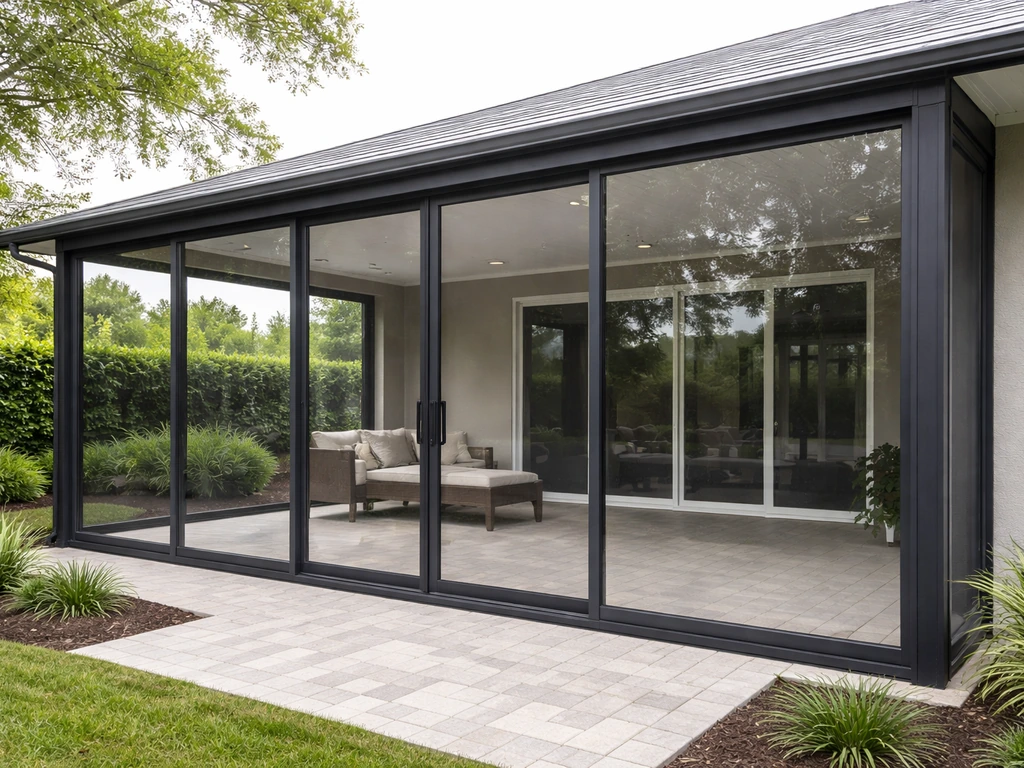
Best Patio Enclosure Companies Near Me: How to Compare
Compare local patio enclosure companies with a checklist: types, quote questions, permits, materials, warranty, and pric
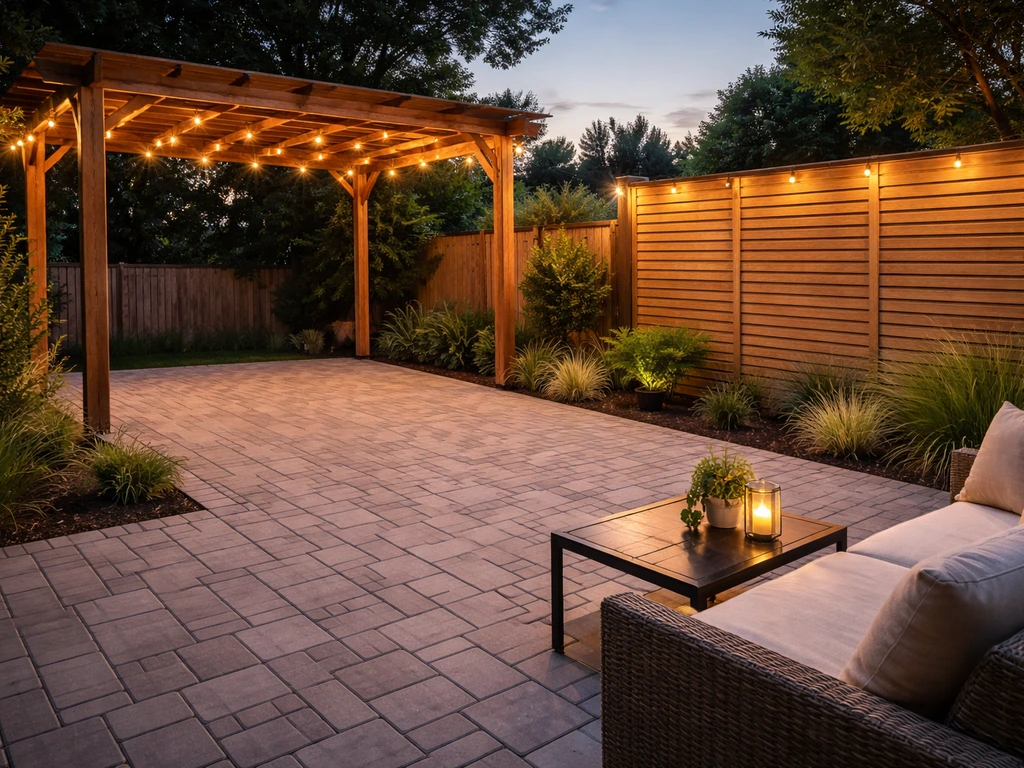
Do It Yourself Outdoor Patio Ideas: Build, Upgrade, Maintain
DIY outdoor patio ideas for planning, building, upgrading, and maintaining floors, shade, privacy, lighting, and decor.
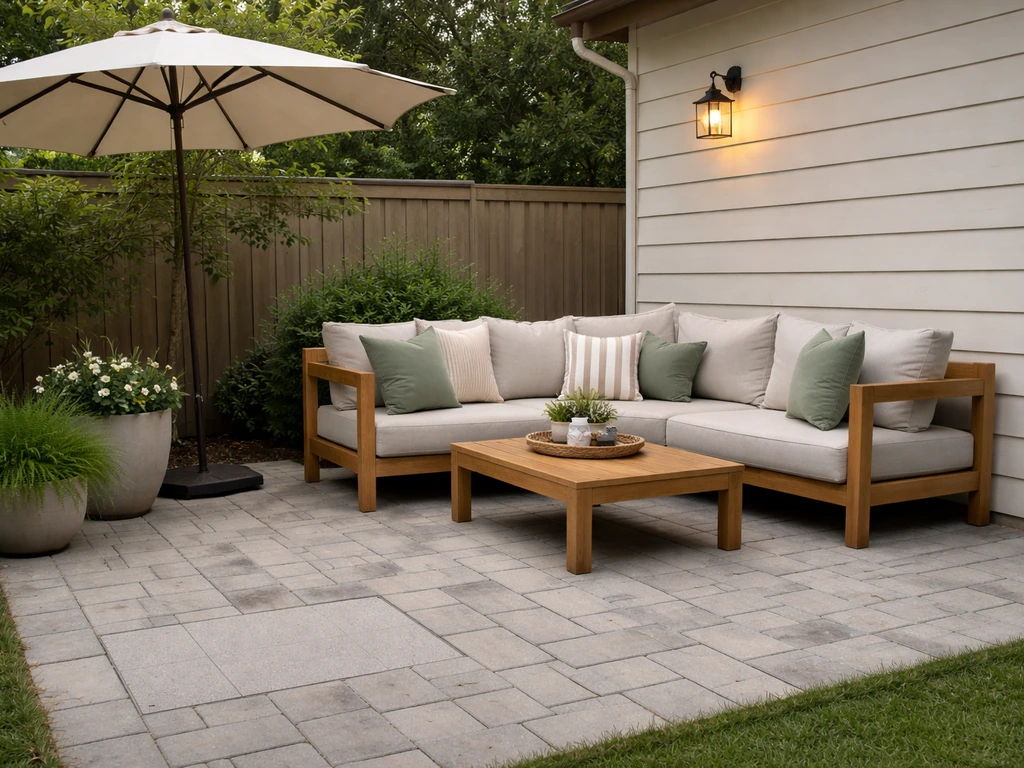
Quick Fix Patio Ideas for Instant Comfort and Style
Quick fix patio ideas for fast comfort and style: cleanups, repairs, shade, flooring tweaks, and safe upgrades on any bu